
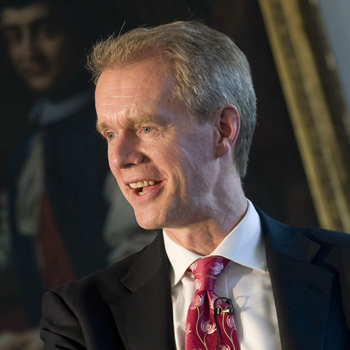
Stephen Sackur presented BBC's Hardtalk which was broadcast on BBC News 24 and BBC World for nearly 20 years. Prior to his appointment, he was the BBC's Chief Europe correspondent between 2002 and 2005, following a 4 year stint in Washington.
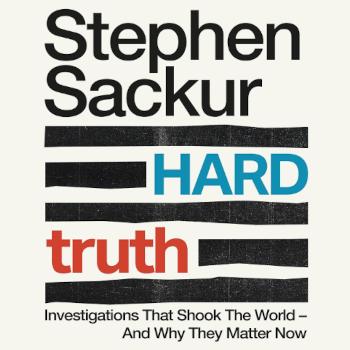 In 2026 he published Hard Truth, in which Stephen re-examines the assumptions underpinning the journalism he grew up with. Is it enough to bear witness and move on? What does impartiality mean when the truth itself is drowning in a sea of distraction, distortion and disinformation? Do we need journalists who see themselves as 'activists for truth'?
Stephen was named International TV Personality of the Year 2010 by the Association of International Broadcasters.
Stephen offers a world of experience in US and foreign affairs news coverage. From the fall of the Berlin Wall to the war ravaged sands of Kuwait, Sackur has covered major breaking stories for over a decade. His insight into the people and places that keep our world spinning is unparalleled. Some of his areas of expertise include:
- U.S. Politics and Culture
Stephen was the BBC's chief Washington correspondent from '97 thru to 2002 and during a momentous five years covered the impeachment of Bill Clinton, the closest election in US political history, the September 11th attacks and America's response - the global war on terrorism.
His reporting from Washington was honoured by the National Academy of Television Arts and Sciences in 2002. Durin his time there he interviewed Presidents Clinton and Bush and all of their closest advisors. - The Middle East
Sackur served as BBC Middle East Correspondent in both Cairo and Jerusalem, covering all aspects of this volatile, fascinating region including: the ups and downs of the peace process, the assassination of Israeli Prime Minister Yizhak Rabin and the emergence of the Palestinian Authority under Yasser Araf.In 1991 he wrote a book about the first Gulf War called 'On the Basra Road' in 1991 - it was a 'Spectator' book of the year.
- Eastern Europe
As witness to Communism's last days in Eastern Europe, Sackur offers a unique perspective on the rocky road to democracy for this important post-Cold War area, and now an assertive Russia under Putin
Stephen's warm yet no nonsense style is highly valued in the corporate market and is available for hosting conferences as well as making keynote speeches, with his wide internation experience making him a natural choice for multinational audiences.
"Stephen did a great job and had complete control over the presentation ceremony which made it run very smoothly. He was very professional and managed to keep to our tight timings....We would definitely consider using Stephen again in the future." Stephen presented the Seatrade Awards
"Stephen hosted two sessions at RenewableUK's Wave and Tidal conference. While he noted that he was not an expert in the area, his knowledge put him far beyond the level of a layman. Furthermore, he used his projected position of relative ignorance to probe deeply into the issues and draw out valuable learning points from the participants in the session. Stephen has an air of authority about him that enables him to control a boisterous discussion while being gentle enough to hear even the softest voices in the room. I felt a particularly pleasing element of Stephen's chairmanship was his ability to sense which people have the most to offer on a certain topic as well as add to a question in a way that draws out the most important points, which would often otherwise have been lost. In all, the sessions hosted by Stephen were highlights for many of the delegates and we hope to engage his services again at our future events." Wave and Tidal development manager, RenewableUK
"Stephen was fantastic and our audience really liked him." Stephen spoke about geo politics and took Q&A at the Foresight Energy Coal Symposium